Quality Dimensions
Diverse approaches to defining information by researchers lead also to inconsistencies in defining the notion of its quality.
Information Quality
Diverse approaches to defining information by researchers lead also to inconsistencies in defining the notion of its quality. According to the most popular definition, the quality of information can be defined as fitness for use.
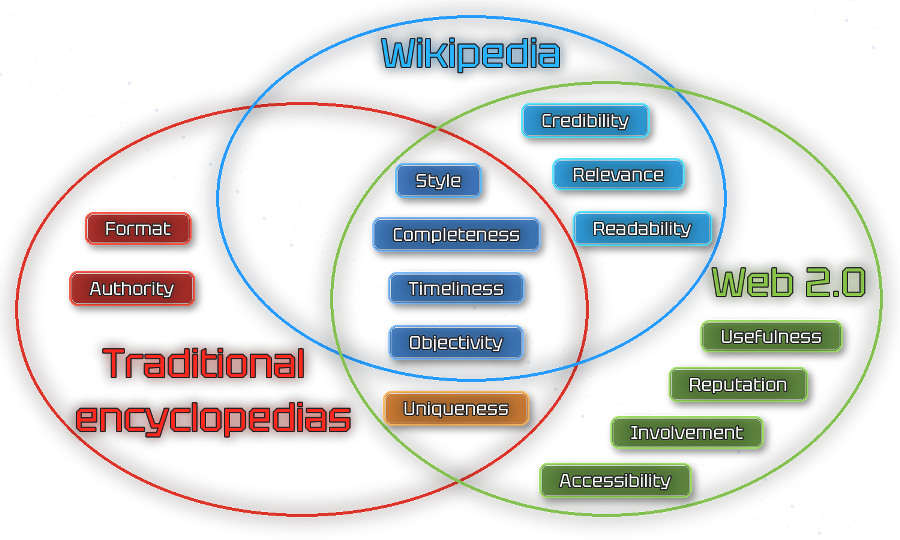
In order to define the quality dimensions in Wikipedia, one should take into account the similarity of this website with traditional encyclopedias and web 2.0 services. On the one hand, content in Wikipedia is created to be a reference point, in an encyclopedic style. According to various studies it has comparable accuracy to other traditional encyclopedias. The quality of an article in a traditional encyclopedia can be defined by 7 dimensions: authority, completeness, format, objectivity, style, timeliness, uniqueness. On the other hand, Wikipedia is built in a way to allow collaboration between users. It is therefore based on web 2.0 technologies, which have the following quality dimensions: accessibility, completeness, credibility, involvement, objectivity, readability, relevance, reputation, style, timeliness, uniqueness, usefulness.
Considering the quality criteria adopted by the Wikipedia community and previously described characteristics of traditional encyclopedia and web 2.0 documents, we can choose the following quality dimensions for the Wikipedia articles: completeness, credibility, objectivity, readability, relevance, style, timeliness.
Dimensions
Completeness
Measures how comprehensive the description of the topic is. Content volume, article length in bytes, characters, and words.
Credibility
Shows whether the information can be checked with reliable sources. Number of references, external link count.
Objectivity
Shows whether the content meets the criterion of a neutral point of view. Number of unique authors, image count.
Reliability
Assesses the reliability of sources used. Academic publications, peer-reviewed materials, deprecated sources detection.
Readability
Measures how understandable the text is. Uses formulas like Flesch, Gunning Fog, Coleman-Liau, and linguistic features.
Relevance
Shows how popular or important the article is for readers. Page visits, watchers, incoming links, PageRank.
Style
Shows how the content is organized. Number of sections, tables, templates, adherence to style guidelines.
Timeliness
Checks if an article describes the current state of reality. Recent edits, unique editors, currency and volatility.
Quality Measures of Wikipedia
Some studies focus on the identification of quality measures (indicators or features) that can describe the characteristics of Wikipedia articles in a structured and measurable way. These quality indicators may include features related to article length, structure, number and reliability of references, edit history, readability, and semantic coherence. By transforming these aspects into quantitative variables, it becomes possible to systematically analyze articles and compare them across topics and languages. Such feature-based representations form the foundation for building models of automatic quality assessment, where machine learning algorithms are used to detect patterns associated with high- and low-quality content.